Office Clearance in Lewisham

Office Clearance Lewisham provides a practical office clearance service in Lewisham for businesses that need workspaces emptied, sorted and left ready for the next stage. We handle the removal of desks, chairs, storage units, filing items and mixed office contents with a clear focus on sensible reuse, responsible disposal and tidy handover. If you need a straightforward way to clear a suite, floor or individual room, our service is built around the actual contents that need moving rather than a one-size-fits-all approach.
The main aim is to make the process manageable for offices that are relocating, reducing surplus furniture, consolidating work areas or closing a site. We can deal with general office items alongside bulky furniture, and we work with customers who want the removal arranged around normal business activity where possible. Clearance is not just about lifting items out; it is also about identifying what stays, what goes and what needs careful handling so the space can be handed back in good order.
If you are planning an office clearance in Lewisham, tell us what needs removing and what the space is used for. You can request a quotation once you have a simple list of the main items.
Office furniture and interior clearances
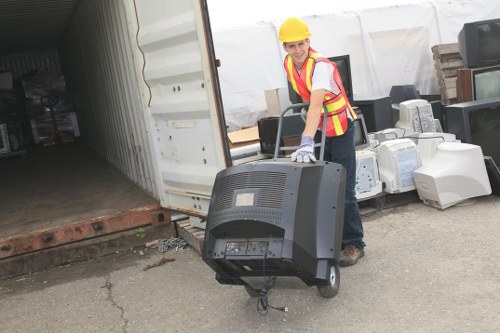
Office furniture is often the largest part of a clearance, so we begin with the items that take up floor space and create the most handling work. Desks, meeting tables, task chairs, cabinets, pedestals and shelving can usually be grouped into a clear removal plan, but mixed offices often need more than one pass through the rooms. We separate furniture from papers, equipment and general contents so that the clearance remains orderly and does not disturb items that are staying behind.
Different office layouts call for different handling. Open-plan floors can be cleared in broad sections, while smaller rooms, storage corners and reception areas may need a slower sequence of work. We also take into account whether items are fitted, freestanding, heavy, awkward to move or positioned in a way that makes safe removal more involved. Where furniture is still in usable condition, a sensible clearance plan can support reuse rather than treating every item as the same kind of waste.
Common items covered in this part of the service include:
- office desks and workstation furniture
- chairs, stools and visitor seating
- filing cabinets, cupboards and drawers
- tables, shelving and storage units
- miscellaneous reception and breakout furniture
Space planning and items that need extra care
Many office clearances involve a mixture of standard furniture and items that need a more careful approach. Archive boxes, locked cabinets, older equipment, decorative pieces and boxed stock can all sit alongside routine furniture removal, and each type of item affects the sequence of work. A good clearance starts with separating what can be removed freely from what may need to be checked, sorted or isolated first. That helps avoid avoidable disruption and keeps the job moving in a controlled way.
We also think about access within the premises. Narrow corridors, lifts, stairwells, shared entrances and loading points can all change how a clearance is organised. If items are large or unusually shaped, the route out of the building may matter as much as the room they are stored in. That is one reason office clearances are better approached as a planned service rather than a last-minute tidy-up. The right sequence reduces delay and makes it easier to keep business areas usable while work is under way.
When the job includes multiple spaces, it can help to split the work into zones. You might clear one floor first, then storage areas, then shared rooms or old desks left in a meeting suite. This kind of breakdown is useful when there is a handover deadline, but it also works well for smaller offices that simply want a fuller reset. Order matters because once the main bulk items are out, the remaining clear-up becomes much easier to judge.
Commercial waste, office contents and disposal routes
Not every office clearance is limited to furniture. Many include mixed office contents such as packaging, stationery, broken accessories, obsolete files, signage, display materials or general commercial waste from storage rooms and work cupboards. We can remove these as part of the same clearance where they fit the agreed scope. The key is to distinguish between items that are part of the office fit-out and items that are simply accumulated waste, because each may need a different handling route.
For customers deciding how to structure a clearance, it is often useful to think about three broad groups: what is staying, what is being removed for reuse or disposal, and what needs checking before it leaves. That keeps the job practical and reduces back-and-forth during the appointment. If there are items you are unsure about, it is better to list them clearly than to assume they can be dealt with in the same way as ordinary waste. Accurate item details lead to a cleaner quotation.
Our commercial removal work is intended to be flexible enough for a range of office contents, but it still benefits from a simple summary before the job begins. If you are unsure whether a box room, archive area or back office should be included, a short description is usually enough to set the scope. The aim is to match the clearance to the actual contents, the access route and the amount of work involved, not to overcomplicate the arrangement.
How to prepare an office clearance

A good office clearance normally starts with a clear view of the rooms, access points and the main items to be removed. In many cases, a short inventory is more useful than a long explanation because it highlights the bulky pieces, the quantity of smaller items and any areas that may need extra attention. If there are restricted spaces, lift access, shared corridors or work areas that must remain undisturbed, those details are worth noting early so the clearance can be planned properly.
The most useful preparation is often simple: identify what must stay, decide whether any items need separating before removal, and let us know about anything unusually heavy, fragile or awkward. Photographs can help when the contents are complex, but they are most useful when they are paired with a brief written description. That keeps the quotation process focused on the practical work rather than guesswork. You do not need to over-explain the site; a clear outline is usually enough.
Before you ask for a quotation, think about whether the office needs a full clear-out or a partial one. Some customers want only unused desks and redundant storage taken away, while others need an entire floor emptied and sorted. The more precisely the clearance is defined, the easier it is to plan. If you are ready to get started, send the item list first and add access notes where relevant.
Lewisham and the shape of the borough

Lewisham is a district and borough in south-east London with a long history shaped by transport routes, suburban growth and riverside connections. The area takes its name from the older settlement that developed near the River Ravensbourne, and over time it became part of a wider urban district with a busy town centre, residential streets and large stretches of Victorian and later housing. The River Ravensbourne and the Waterlink Way corridor remain important threads in the local landscape, linking parks, open spaces and neighbourhoods across the borough. Hither Green, Brockley, Catford, Deptford and New Cross each contribute distinct character, while the borough’s transport links connect it closely with central London and neighbouring parts of south-east London.
Clearance work for changing offices
Office clearance often becomes necessary when a business is changing how it uses its space. That might mean replacing older furniture, consolidating workstations, clearing a room for new layouts or emptying storage that has become difficult to manage. In practical terms, the work usually starts with larger items, then moves through grouped contents, then finishes with the smaller pieces that are easy to overlook. A careful sequence helps the room feel properly cleared rather than simply stripped of the obvious furniture.
It is also common for offices to contain a mixture of serviceable and non-serviceable items. Some pieces may be ready for reuse, some may be outdated but intact, and some may be damaged or beyond practical use. A sensible clearance takes these differences into account. That is one reason why office work should not be treated as a simple lift-and-tip exercise. The content of the room influences the method, and the method affects how smoothly the clearance runs from start to finish.
If your office includes areas such as reception desks, meeting rooms, staff rooms or back-office storage, it is worth separating those areas in your own notes before requesting help. A clear room-by-room outline can make the plan easier to follow and can reduce confusion about what is included. The goal is not to produce a perfect schedule, only to make sure the clearance is built around the actual space you want emptied.
Items that commonly appear in office clearances
Office clearances often include a familiar mix of furniture, equipment and miscellaneous contents. We deal with the removal side of the job, while the customer decides what stays and what is to be included. In practical terms, that means the contents are sorted into workable groups so that the clearance stays efficient and the right items are removed from the right areas. This matters especially when the office has been used for several years and the contents have built up in stages.
Typical items can include desk units, office chairs, storage cabinets, shelving, meeting tables, filing material, boxed stock, display items and general room contents. Some offices also hold older accessories, packaging, office machines or surplus furniture stored in corners and cupboards. A clear scope helps avoid confusion over what is part of the clearance and what is outside it. If you are dealing with mixed contents, it is often best to note the bulky pieces separately from the smaller items.
For customers arranging a quotation, the most helpful thing is to describe the volume and type of items rather than to focus only on the fact that an office is being cleared. Two offices of similar size can involve very different amounts of work depending on how densely they are furnished, whether items are stacked, and how easily they can be moved. That is why a practical description of the contents is more useful than a broad label alone.
Business moves, closures and handover clean-downs
Some office clearances are tied to a move, while others are needed because a lease is ending or a site is being reorganised. In either case, the clearance has to fit the handover point, the layout of the premises and the condition in which the space needs to be left. The work can be adapted for partial clearances as well as fuller jobs, so the scope does not need to be larger than necessary. What matters is that the right items are removed in a logical order.
It can help to think about the clearance in terms of rooms rather than simply the whole office. A reception area may need a different approach from a storage room, and a meeting room may contain bulky furniture with fewer small loose items. Where there are several spaces, it is usually more efficient to tackle the biggest or most crowded room first and then move through the remaining areas in sequence. That keeps the work organised and makes it easier to see progress.
When a business is preparing to hand over premises, it is wise to confirm which items are excluded from the clearance before the work starts. That avoids accidental removal of fixtures, documents or contents that still belong on site. If in doubt, list the items that are staying and the items that are leaving. The clearer that split is, the easier it becomes to request a fair quotation and arrange the removal without last-minute changes.
What affects a quotation for office clearance
Office clearance quotations are usually influenced by the amount of material to be removed, the nature of the items and the access to the property. A floor full of standard desks and chairs is a different task from a small room packed with mixed furniture, archive boxes and awkward storage units. Likewise, a simple ground-floor clearance is not the same as a job that involves lifts, stairs, narrow corridors or loading restrictions. These factors matter because they affect the time and handling involved.
It is sensible to describe the job in practical terms. Include the number of rooms, the main furniture types, any bulky pieces and anything that needs special attention. If there are items that may require sorting before removal, mention them clearly. That gives a more realistic starting point for the quotation and helps avoid assumptions. The more directly the clearance is described, the more useful the estimate is likely to be.
You do not need to prepare a long brief. Often, a few lines about the space, the main items and the access conditions are enough to begin. If there are photographs, they can support the description, but they should not replace it. Simple, accurate information is usually the quickest route to a workable quote. That is especially true when the office contains a mix of furniture, storage and commercial waste in the same area.
Recycling, reuse and responsible disposal
Office clearances are more useful when the contents are handled with care rather than simply removed without sorting. Furniture and equipment may need different disposal routes, and some items are better separated for reuse where that is appropriate. Our service is focused on removing office contents in a responsible way that reflects the type of material involved. That means we look at the mix of items before deciding how the clearance should be approached.
This is especially important with office furniture, because desks, chairs and cabinets often remain intact even when they are no longer needed in their current setting. Other items may be damaged, outdated or unsuitable for reuse, so they need a different route. A considered clearance helps keep the work tidy and gives the customer a more controlled way to deal with unwanted contents. It also reduces the chance of mixing different types of material unnecessarily.
If sustainability matters to your organisation, it is worth saying so when you request a quotation. That does not change the practical scope of the work, but it does help shape how the clearance is organised. Different items can be separated more thoughtfully when the service provider knows that reuse, recycling and disposal all need to be considered as part of the job.
Requesting your quotation
To request a quotation for office clearance in Lewisham, start with the basics: the site address, the rooms to be cleared, the main furniture types and any access details that could affect the work. If the office contains a mix of desks, seating, storage and smaller contents, list the main groups rather than trying to catalogue every single item. A concise description is often enough to begin the process and can save time later when the scope is being confirmed.
It is also helpful to say whether the job is a full clearance, a partial clearance or a staged removal. That distinction matters because each type of job involves a different level of organisation. If you have deadline pressure, a handover date or particular times when access is possible, include that too. We can then shape the clearance around the practical limits of the premises rather than treating every office in the same way. If you are unsure where to start, send the main item list first and add the rest after.
Contact us to request a quotation or use the details on the website to outline the clearance you need. A clear, brief summary is enough to begin.